
You are here
Afrique
Mexico Experiments With Residential Solar Panels, But They Are Still Insufficient
A wind farm in the state of Baja California, in Northwestern Mexico. This territory depends on fossil fuels for electricity generation, while the contribution of renewables is still low, but it is gradually moving towards residential solar generation. Credit: Sempra
By Emilio Godoy
MEXICO, Sep 15 2025 (IPS)
Over the past four months, Mexican researcher Nicolás Velázquez has paid around US$23 for electricity, thanks to the photovoltaic system installed in his home in the northern city of Mexicali.
“You can see the direct benefit. My neighbor received a bill over US$400. The problem is the high temperatures, which double demand” from March to August, said Velázquez, coordinator of the Center for Renewable Energy Studies at the Engineering Institute of the public Autonomous University of Baja California.
Due to the high temperatures in cities such as Mexicali, capital of the northwestern state of Baja California, people need air conditioning systems during the summer, which increases electricity consumption in a state with 3.77 million inhabitants, affected by a shortage of infrastructure and generation.“Distributed generation is better for us. It is done by Mexican companies. We import the technology, but there is a chain of Mexican participation. We participate from engineering onwards, activating the economy to a certain level, helping the residential sector”–Nicolás Velázquez.
In late August, residents of several neighborhoods in Mexicali blocked the highway between that city and neighboring Tijuana due to a lack of electricity.
In an attempt to alleviate the situation, the Mexican government launched the Techos Solares del Bienestar (Solar Roofs for Welfare) program in March, aimed at low-income homeowners who pay high rates and consume between 400 and 1,000 kilowatt hours between July and August, so they receive solar panels for their homes in Mexicali and the neighboring municipality of San Felipe.
It is one of the steps to relaunch the energy transition to less polluting sources that the previous government halted in 2018.
The initial plan is to install solar panels in 5,500 homes in Mexicali with an investment of around US$10 million. The ultimate goal is to cover 150,000 homes by 2030. The scheme promises to reduce electricity bills from 49% to 89%.
For Velázquez, the central question revolves around the advisability of resorting to centralized or distributed generation, which consists of electricity production by systems of many small generation sources close to the end consumer.
“Distributed generation is better for us. It is done by Mexican companies. We import the technology, but there is a chain of Mexican participation. We participate from engineering onwards, activating the economy to a certain level, helping the residential sector,” he said from Mexicali.
In his opinion, “there has to be a balance between centralized and distributed generation, because there will not be a single solution. More energy justice is achieved through distributed generation.”
In Mexico, home to some 129 million people, there are at least 12,000 communities without electricity and some 9,000 homes without connection to the national grid, a quarter of which are located in Mexicali, which had 1.05 million inhabitants according to the 2020 census.
Small-scale or distributed generation is on the rise in the country.
Since 2007, the government’s Energy Regulatory Commission has authorized 518,019 licenses for a distributed energy generation capacity of 4,497 megawatts (MW). In 2024, it approved 106,934 interconnections for 1,086 MW.
The western state of Jalisco and the northern states of Nuevo León and Chihuahua top the list, while Baja California ranks 14th among the 32 Mexican states.
In July, the government’s National Energy Commission updated the regulations for interconnected self-consumption for installations between 0.7 and 20 MW, which expands the margin for distributed generation, also known as citizen generation.
Solar panels in a community in the municipality of Ensenada, in the northwestern state of Baja California. The existing microgrid in that town provides electricity to the small community. Credit: Secihti
More promises
The energy policy of president Claudia Sheinbaum, in office since October 1, has so far been marked more by proposals than by concrete actions, and Baja California is no exception to this dynamic.
Her government will allocate US$12.3 billion for electricity generation, US$7.5 billion for transmission infrastructure, and US$3.6 billion for decentralized photovoltaic production in homes.
The plan would add 21,893 MW to the national energy matrix, reaching 37.8% clean energy from the current 22.5%, so that the state-owned Federal Electricity Commission (CFE) would hold 54% of the market, with the rest going to private and individual entities.
On August 26, the president announced the construction of two solar thermal plants in the state of Baja California Sur, which shares a peninsula with Baja California, with a public investment of US$800 million to generate more than 100 MW. The territory is also isolated from the national grid and suffers from a chronic energy deficit.
Solar thermal energy converts solar radiation into electricity using mirrors to generate steam and drive turbines, as well as enabling energy storage.
The CFE plans to tender phase II of the Puerto Peñasco photovoltaic plant, in the town of the same name in the northern state of Sonora, with a capacity of 300 MW and 10.3 MW of battery backup. The first 120 MW phase of this facility has been operating since 2023. Completed in 2026, it will contribute 1,000 MW at a cost of US$1.6 billion.
However, the Mexican government continues to promote fossil fuels, despite the urgency of phasing them out, as it seeks to strengthen the CFE and the state-owned Petróleos Mexicanos.
All of this impacts places such as Baja California, where 16 public and private power plants operate, with an installed capacity of 3,461 MW, including three wind farms with more than 300 MW of capacity and three solar farms with 50 MW.
The private company Sempra Infraestructura, a subsidiary of the US company Sempra, is building a wind farm with a capacity of 300 MW, which is expected to be operational in 2026. In addition, CFE operates a 340 MW geothermal plant.
Despite its shortcomings, the state exports around 1,100 MW to the neighboring US state of California and imports around 400 MW. Baja California could produce 6,550 MW of solar power, 3,495 MW of wind power, and 2,000 MW of geothermal power.
In addition, CFE is building two combined-cycle power plants in Baja California that burn gas and generate steam to drive turbines, which would reduce blackouts.
The country faces insufficient production to meet annual demand growth of about 4% and an obsolete power grid.
In the first half of 2025, the country generated 310.49 terawatt-hours, virtually the same as during the same period last year. Some sources, such as gas, hydroelectric, wind, and photovoltaic, increased, but others, such as thermoelectric and nuclear, decreased.
In Mexico, electricity generation depends mainly on fossil gas, followed by hydroelectricity and nuclear energy. Renewable sources have a capacity of 33,517 MW, but only contribute one-fifth of the electricity produced.
Energy map of the northern Mexican state of Baja California. Electricity generation is not enough to meet growing demand, causing frequent blackouts. Credit: Government of Baja California
New schemes
Baja California’s 2022-2027 Energy Program consists of four strategies, including providing access to electricity to remote communities and unregulated housing, as well as promoting the rapid transition to decarbonization and the use of clean energies.
In addition, it envisions eight outcomes, including the promotion of two annual microgrid power generation projects for isolated communities and a 3% increase in alternative electricity generation. However, there is no evidence of progress toward these goals.
If it so desired, the Mexican government could transform its national electricity subsidy of more than US$5 billion annually into distributed generation.
The Universal Electricity Service Fund is a case in point. Intended to cover marginalized communities, available data indicate that it has covered more than 1,000 municipalities out of a total of 2,469, including two in Baja California, since 2019.
Velázquez proposed that these funds could finance solar panels and microgrids.
“Year after year, they give a subsidy, but if these families were provided with a photovoltaic system, it would solve the problem at its root. We need to look for more far-reaching measures; the actions have to be different,” he said.
In December 2023, during the climate summit in Dubai, United Arab Emirates, Mexico joined the Global Renewables and Energy Efficiency Pledge, which consists of tripling alternative installed capacity and doubling the energy efficiency rate by 2030. In comparison, Sheinbaum’s plans fall short.
Turquie : devant la barre, İmamoğlu dénonce un procès « honteux »
Il est en détention provisoire depuis mars et subit procès sur procès. Vendredi, Ekrem İmamoğlu était jugé pour « falisification de diplôme ». Récit d'une audience dont l'ancien maire d'Istanbul se sert pour s'adresser à toute la Turquie depuis la prison haute sécurité de Silivri.
- Articles / Une - Diaporama, Courrier des Balkans, Turquie, Défense, police et justice, Politique, Erdogan
Categories: Afrique, Balkans Occidentaux
Petkovic réagit aux critiques et défend Mahrez et ses choix
Le président de la Fédération algérienne de football (FAF), Walid Sadi, a eu un tête-à-tête avec le sélectionneur national, Vladimir Petkovic. Les deux hommes ont […]
L’article Petkovic réagit aux critiques et défend Mahrez et ses choix est apparu en premier sur .
Categories: Afrique, Határon túli magyar portálok összesített hírei
121/2025 : 2025. szeptember 15. - Ünnepélyes ülés
Új tagok hivatalba lépése a Bíróságon és az Európai Unió Törvényszékén, valamint a Törvényszék részleges megújítása
Categories: Afrique, Európai Unió : hírek magyarul
En Allemagne, les conservateurs devraient remporter les élections locales, tandis que l’extrême droite progresse
Les habitants de Rhénanie-du-Nord–Westphalie, l’État le plus peuplé d’Allemagne, se sont rendus aux urnes dimanche 14 septembre. Ce scrutin, le premier depuis l’entrée en fonction du chancelier conservateur Friedrich Merz, était considéré comme un test décisif pour son gouvernement de coalition à Berlin.
The post En Allemagne, les conservateurs devraient remporter les élections locales, tandis que l’extrême droite progresse appeared first on Euractiv FR.
Categories: Afrique, Union européenne
Gouvernement Ghrieb : 9 femmes à la tête de ministères clés
Le nouveau gouvernement algérien se dessine sous de nouveaux auspices. Sous la direction de Sifi Ghrieb confirmé dans ses fonctions, neuf femmes prennent place autour […]
L’article Gouvernement Ghrieb : 9 femmes à la tête de ministères clés est apparu en premier sur .
Categories: Afrique, Határon túli magyar portálok összesített hírei
Scène hollywoodienne à Ghardaïa : des motards cagoulés et armés braquent un fourgon de fonds
Ce dimanche matin, une véritable scène digne d’un film hollywoodien s’est déroulée sur la route reliant le carrefour de Brezina à Sebseb, lorsqu’un fourgon de […]
L’article Scène hollywoodienne à Ghardaïa : des motards cagoulés et armés braquent un fourgon de fonds est apparu en premier sur .
Categories: Afrique, Határon túli magyar portálok összesített hírei
Inside Africa’s Big Bet on Youth to Feed the Continent and Who’s Actually Getting Funded
Winnie Wambui, co-founder of Harcourt Agri-Eco Farm in Kenya, speaks to IPS outside the Dealroom at the Africa Food Systems Forum 2025, held at the Centre International de Conférences Abdou Diouf (CICAD) in Dakar, Senegal, September 4, 2025. Credit: Chemtai Kirui/IPS
By Chemtai Kirui
DAKAR, Sep 15 2025 (IPS)
Winnie Wambui leans forward on the panel stage, microphone in hand, scanning the room until she spots a raised hand.
Everyone in the room wears headphones, each voice isolated so that discussions don’t clash with sessions in adjacent halls. A question cuts through: how did a student science project become a commercial business?
At 24, Wambui, a Kenyan agripreneur, runs Harcourt Agri-Eco Farm, which recycles organic waste into animal feed using black soldier flies.
“Back then, I didn’t know it would become a farm or a business,” she said to a room of agripreneurs, researchers, and investors, describing her first experiments in 2022 as an energy engineering student at Jomo Kenyatta University of Agriculture and Technology (JKUAT).
Today, her eight-person team processes around 30 tonnes of waste each month and monitors the carbon emissions avoided.
The enterprise now generates at least USD 1,000 in monthly revenue, a modest but steady profit by Kenyan standards.
Inside the calm Knowledge Hub, on a panel organized by the International Centre of Insect Physiology and Ecology (icipe), Wambui tells her story to a dozen listeners in an intimate, almost subdued setting. But just outside, at the leafy Centre International de Conference’s Abdou Diouf (CICAD) in Dakar, Senegal, the atmosphere is charged.
Presidents, cabinet ministers, development banks, and agribusiness executives pace the halls at the annual Africa Food Systems Forum (AFSF) 2025, the continent’s flagship platform for agricultural policy and investment.
This year, the forum positioned youth at the center of Africa’s food security agenda.
Wambui is part of a new generation of innovative agripreneurs that governments and financiers promise to support.
For the first time, youth agripreneurs joined heads of state on the Forum’s opening stage, a symbolic gesture of recognition in a region where nearly 400 million people are under 35.
“Our median age is just 19. And by 2050, one in three young people in the world will be African,” said Claver Gatete, Executive Secretary of the UN Economic Commission for Africa (UNECA).
He said that if given land, finance, technology and markets, the youths can feed not only Africa but also the world.
However, turning such vision into reality is where the continent struggles.
The African Development Bank (AfDB) often says that Africa holds roughly 60 percent of the world’s uncultivated arable land, yet poor infrastructure, limited financing, and climate shocks keep much of it idle.
With the continent collectively importing approximately USD50 billion worth of food annually, according to the African Export–Import Bank (Afreximbank), the stakes are high.
At the national level, countries like Kenya continue to face hunger crises at emergency levels.
At the start of the year, the World Food Programme estimated that around two million people were experiencing acute hunger—a recurring crisis in a country with relatively better infrastructure and higher investment flows than many of its East African neighbors.
Experts say that despite localized crises, structural issues in African agriculture worsen food insecurity across the continent.
“We have relied on grants and aid to keep agriculture afloat, and this has made the agriculture sector stuck in a risk perception trap,” said Adesuwa Ifedi, Vice President of Africa Programs at Heifer International.
Ifedi said that commercial banks and investors avoid the sector, leaving grants to fill the gap. But grant dependence can undermine ventures in the eyes of private financiers.
“Grants should leverage commercial capital so the ecosystem can thrive,” Ifedi said.
This year’s Forum coincided with the recent African Union’s rollout of its Kampala Comprehensive Africa Agriculture Development Programme (CAADP) Strategy & Action Plan (2026–2035), or CAADP 3.0.
The new 10-year plan aims to mobilize USD 100 billion in investment, raise farm output by 45 percent, cut post-harvest losses in half, triple intra-African agrifood trade by 2035, and place youth inclusion at the core of Africa’s food future under the AU’s Agenda 2063.
In Dakar, over 30 agriculture ministers gathered under the chairmanship of former Ethiopian Prime Minister Hailemariam Desalegn Boshem, pledging to move beyond policy drafting toward delivering tangible results for agribusiness investment.
Their top priority, they said, was to shrink Africa’s food import bill by strengthening regional value chains.
Dr. Janet Edeme, head of the Rural Economy Division at the African Union Commission, told IPS that the Forum provides mechanisms to operationalize CAADP 3.0, aiming to empower at least 30 percent of youth in the agri-food sector while closing a USD 65–70 billion annual financing gap for agricultural small and medium-sized enterprises (agri-SMEs).
She said AFSF offers a rare opportunity for youthful agripreneurs to showcase bankable projects, access mentorship, and meet investors who would otherwise be out of reach.
“There are dedicated spaces—deal rooms, youth innovation competitions, investment roundtables—where these innovators can connect with governments, development finance institutions, and private investors,” said Edeme.
Organizers pointed to new spaces for youth to meet investors, but agripreneurs like Wambui said those opportunities felt distant.
She had never heard of the AU’s new flagship plan.
“I’m only hearing about that from you. If it’s meant to guide Africa’s food future, why aren’t there clear materials or programs I can see and use?” Wambui said. “Otherwise, we leave without knowing what strategies exist to support our work.”
By day two of the six-day forum, she had found her way into the deal room, the flagship space to connect entrepreneurs with investors, but instead of streamlined matchmaking, she found confusion.
“We are looking for the investors, and they’re looking for us—yet we don’t meet. Deals still depend on connections. That’s why I came to Dakar.”
Wambui, who co-founded Harcourt Agri-Eco Farm with two other partners, said the business has grown enough to cover wages, taxes, and debt repayments. Banks now extend her loans.
But that access to financing remains an exception in a system stacked against most, said Dr. Eklou Attiogbevi-Somado, the African Development Bank’s Regional Manager for Agriculture and Agro-Industry in West Africa.
He said that AfDB data shows commercial banks in Africa channel just 3–4 percent of their lending into agriculture.
Dr. David Amudavi, CEO of Biovision Africa Trust, said this capital drought is a huge concern in a sector that drives most livelihoods on the continent.
Amudavi, whose non-profit organization promotes ecological agriculture, said that the squeeze leaves farmers, and especially young agripreneurs, struggling to access credit for starting or scaling their agribusinesses, even though nearly 60 percent of Africa’s unemployed are under 25.
“Without finance, many youth-led ventures stay stuck at micro-scale or collapse,” Amudavi said.
Not far from the Youth Dome, at the deal room, Tanzanian agripreneur Nelson Joseph Kisanga, the co-founder of Get Aroma Spices, is also navigating the same maze.
Seven years ago, he left a banking career to try poultry farming, losing almost everything in his first three years.
Kisanga regrouped, merged his venture with that of his wife, Deborah, also a young agripreneur, and built Get Aroma Spices, now working with more than 50,000 farmers across southern Tanzania.
“Agriculture back home is seen as not for young people,” he said. “Even now, scaling means loans at high interest rates. There’s no other way.”
The family-run company exports turmeric, ginger, cardamom, and avocado oil while operating a youth- and women-led agro-processing hub through a public-private partnership.
His presence at the AFSF forum has already borne fruit.
“My intention coming here was to break into the West African market, and I’m happy to say I have clinched a supply deal in Ghana. All that’s left is for the lawyers to finalize the contract.” Kisanga said, before moving to the Youth Dome, a separate pavilion for young participants.
Inside, some groups chatted, others played basketball and table tennis, while others listened as young agri-food innovators pitched their ideas to a panel of investors.
Despite the fanfare, the forum ended without revealing how much capital reached youth-led ventures.
The most visible funding for youth at the summit came via the GoGettaz Agripreneur Prize, a pan-African initiative under the Generation Africa movement. The prize awarded USD 50,000 each to Egypt’s Naglaa Mohammad, who turns agricultural waste into natural products, and Uganda’s Samuel Muyita, who uses nanotechnology to reduce post-harvest fruit and vegetable losses.
An additional USD 60,000 impact award brought total prizes to roughly USD 160,000.
Other announcements included a USD 6.7 million trade programme from the United Kingdom (UK), the Alliance for a Green Revolution in Africa (AGRA), and the African Union (AU).
Senegal also launched a USD 22.5 million pilot for Community Agricultural Cooperatives, with financing linked to the African Food Systems Resilience Fund.
Yet there was no breakdown showing how much, if any, flowed to youth-led ventures.
The opacity mirrors past patterns.
Public summaries from the 2023 deal room reported only USD 3.5 million in closed investments, with no traceable flows to youth-led enterprises.
With AFSF positioned as Africa’s premier delivery platform, observers measured the announcements against CAADP 3.0’s USD 100 billion mobilization target, saying the gap is stark.
“We have seen this pattern before: big pledges at the summit, but little clarity or follow-up on how much actually reaches youth and smallholder farmers—the backbone of African food production,” said Famara Diédhiou, a Senegal-based food systems program manager with a regional civil society network.
“Without such accountability and inclusion of all stakeholders, these forums risk becoming mere showcases rather than platforms that deliver,” he said.
For now, even with the youth-first theme, AFSF still leaves young founders stuck in the same cycle of chasing visibility, hustling for contacts, and stitching together their own contracts.
As Wambui found, Kisanga, who has attended three previous Forums, said that in AFSF access is everything: you need to know in advance who to meet and be in the right room at the right moment.
“All visibility is currency,” said Kisanga. “That’s how you survive.”
IPS UN Bureau Report
Follow @IPSNewsUNBureau
!function(d,s,id){var js,fjs=d.getElementsByTagName(s)[0],p=/^http:/.test(d.location)?'http':'https';if(!d.getElementById(id)){js=d.createElement(s);js.id=id;js.src=p+'://platform.twitter.com/widgets.js';fjs.parentNode.insertBefore(js,fjs);}}(document, 'script', 'twitter-wjs');
IPS UN Bureau, IPS UN Bureau Report, Senegal,
Related Articles- Africa, Biodiversity, Climate Change, Climate Change Finance, Development & Aid, Economy & Trade, Editors' Choice, Environment, Featured, Food and Agriculture, Food Systems, Headlines, TerraViva United Nations Climate Change Finance Kenyan Biochar Project Becomes First in Africa Validated Under European Carbon Standard
- Kenya Pilots AI System to Protect Black Rhino Calves in Aberdare National Park
Belgique : le Premier ministre soutient le chef d’orchestre israélien déprogrammé d’un festival à Gand
Bart De Wever soutient le chef d’orchestre israélien Lahav Shani, déprogrammé d’un festival à Gand, dénonçant une décision basée sur l’origine de l’artiste.
The post Belgique : le Premier ministre soutient le chef d’orchestre israélien déprogrammé d’un festival à Gand appeared first on Euractiv FR.
Categories: Afrique, Union européenne
Are we using the wrong world map?
This is why the African Union has backed calls to stop using the Mercator map of the world.
Le Qatar accueille un sommet arabo-islamique d'urgence suite à la frappe israélienne sur Doha
Un projet de résolution indiquerait que les « actes hostiles » israéliens menacent la paix au Moyen-Orient.
Categories: Afrique, European Union
Schwedens Regierungschef kontert Orbáns ‘Barbarei’-Aussage
Der schwedische Ministerpräsident Ulf Kristersson hat Ungarns Regierungschef Viktor Orbán der Lüge bezichtigt, nachdem dieser Schweden wegen Jugendkriminalität in den Zustand der „Barbarei“ versetzt sah.
Categories: Afrique, Europäische Union
Bonne nouvelle pour les voyageurs : Air Algérie renforce ses vols vers l’Espagne
Air Algérie renforce son réseau international. La compagnie nationale vient d’annoncer la reprise de ses vols réguliers entre Oran et Barcelone, en Espagne. Auparavant, ces […]
L’article Bonne nouvelle pour les voyageurs : Air Algérie renforce ses vols vers l’Espagne est apparu en premier sur .
Categories: Afrique, Határon túli magyar portálok összesített hírei
Arab, Muslim leaders hold emergency talks after Israel’s Qatar attack
Hamas says top officials survived last week's air strike in Doha that killed six people and triggered a wave of criticism, including from US President Donald Trump
Categories: Afrique, European Union
Les acteurs du commerce transfrontalier sensibilisés sur le certificat phytosanitaire
La Chambre de Commerce et d'Industrie du Bénin (CCI Bénin) a organisé, vendredi 12 septembre 2025, en partenariat avec l'Agence régionale pour l'agriculture et l'alimentation (institution spécialisée de la CEDEAO), un atelier de sensibilisation des acteurs du commerce transfrontalier sur le certificat phytosanitaire harmonisé et autres dispositions communautaires facilitant le commerce intra-régional des produits agro-sylvo-pastoraux. Cet atelier s'inscrit dans le cadre du Programme de résilience du système alimentaire en Afrique de l'Ouest (PRSA/FSRP), soutenu par la Banque Mondiale.
Sensibiliser les acteurs du commerce transfrontalier sur le certificat phytosanitaire harmonisé afin de réduire, voire éliminer les obstacles/tracasseries aux échanges de produits agropastoraux. C'est l'objectif de cet atelier de sensibilisation ayant réuni les autorités, représentants d'association et parties prenantes au commerce transfrontalier. Dans son mot d'ouverture, Razack Yessoufou, représentant de la CCI Bénin et coordonnateur du Projet facilitation du commerce transfrontalier a salué les efforts réalisés par la CEDEAO pour optimiser le commerce en Afrique de l'Ouest et réduire les obstacles qui limitent les échanges intra-communautaires. « La CCI Bénin ne ménagerait aucun effort pour accompagner cette dynamique. Que ce soit au Bénin ou un peu partout dans la CEDEAO, c'est le secteur privé qui est au cœur de l'activité économique. C'est le secteur privé qui crée la richesse », a déclaré Razack Yessoufou.
Le certificat phytosanitaire fait référence à l'état phytosanitaire de végétaux ou produits végétaux destinés à l'exportation ou à la réexportation. Il engage les Etats de reconnaître le droit de protéger la vie humaine, animale, végétale ou la santé, tout en évitant les barrières techniques non-nécessaires au commerce. « Un produit inspecté au Bénin selon les règles de l'art et qui est sanctionné par la délivrance d'un certificat ne devrait pas être sujet à contradiction dans un autre pays, tout simplement parce qu'on se sera accordé sur la procédure de faire et sur le document à fournir. C'est cet exercice qui a été fait ces deux à trois dernières années et a abouti à l'adoption du certificat phytosanitaire harmonisé », a expliqué Justin Bayili, consultant à la commission de la CEDEAO.
L'atelier de sensibilisation s'inscrit dans le cadre du Programme de résilience du système alimentaire en Afrique de l'Ouest (PRSA/FSRP), soutenu par la Banque Mondiale. La 3e composante de ce programme est axée sur l'harmonisation des politiques commerciales régionales agricoles et les questions critiques de résilience du système alimentaire. « Par rapport à l'harmonisation des politiques commerciales, il y a le guide sanitaire d'inspection et le certificat phytosanitaire harmonisé. Il y a six pays qui ont déjà bénéficié de cet appui en termes de formation sur le guide phytosanitaire harmonisé et de sensibilisation des acteurs sur le certificat phytosanitaire. Le Bénin est le 7e pays », a affirmé Daouda Coulibaly, Adjoint au coordonnateur du FSRP.
Vue partielle des participants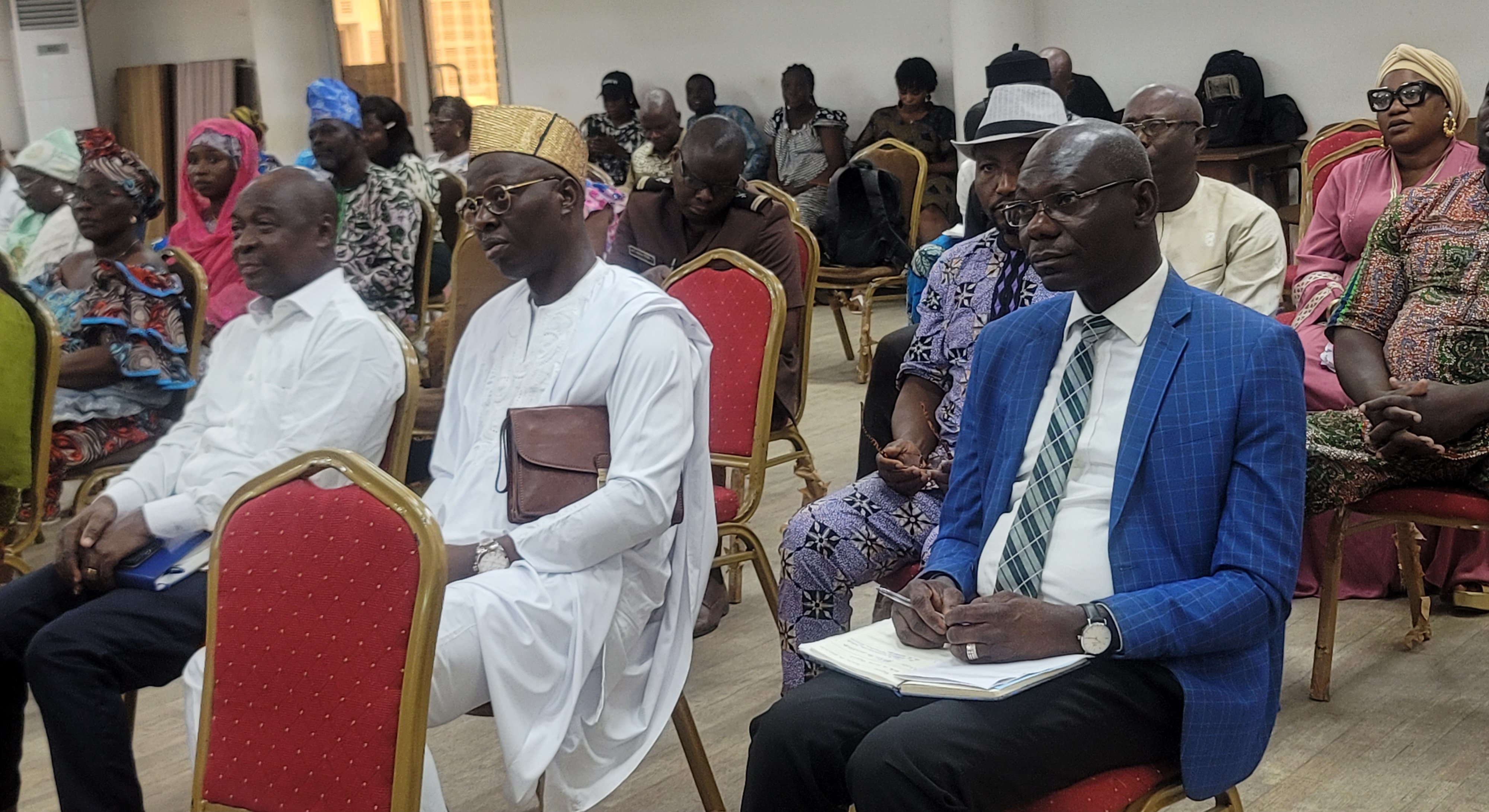
Le secrétaire général de la section béninoise de l'Association Ouest-Africaine du Commerce Transfrontalier des Produits Agro-Sylvo-Pastoraux et Halieutiques (AOCTAH), Moussilou Yessoufou a souligné les défis réels auxquels font face les transporteurs et commerçants au quotidien. Il cite entre autres les prélèvements illicites, les contrôles répétés le long des corridors, les pertes de temps sur les corridors et au niveau de la traversée des frontières. L'harmonisation du certificat phytosanitaire est une avancée majeure dans l'espace CEDEAO. « C'est un instrument qui vient renforcer ce que nous avons mis en place. Un document qui est émis par un pays doit normalement être reconnu par l'autre pays », a soutenu Moussilou Yessoufou. Selon lui, il ne devrait pas avoir un double contrôle des produits agro-Sylvo-Pastoraux et halieutiques. « Ce sont des produits périssables et on devrait travailler à faire que la célérité existe dans l'acheminement de ces produits. C'est à ça que nous nous travaillons », a ajouté Moussilou Yessoufou.
La séance a permis d'échanger sur l'ampleur des obstacles et tracasseries aux échanges transfrontaliers et sur le mécanisme de reconnaissance mutuelle et utilisation correcte du certificat phytosanitaire harmonisé. À l'issue de cet atelier, des recommandations et mesures pertinentes de lutte contre les obstacles techniques au commerce ont été formulées. Avec la mise en œuvre effective du certificat phytosanitaire harmonisé, la CEDEAO espère lever un verrou majeur à la libre circulation des produits agropastoraux et renforcer l'intégration économique sous-régionale.
Akpédjé Ayosso
Categories: Afrique, Swiss News
La « dame de fer » de Côte d'Ivoire : de la clandestinité dans un bunker à la course à la présidence
Redoutée par certains, aimée par d'autres, l'ancienne première dame Simone Gbagbo en lice pour la présidence du pays.
Categories: Afrique, Europäische Union
Doha : Mandaté par Tebboune, Attaf représente l’Algérie au sommet arabo-islamique d’urgence
Mandaté par le Président de la République, M. Abdelmadjid Tebboune, le ministre d’État, ministre des Affaires étrangères, M. Ahmed Attaf, est arrivé dimanche soir à […]
L’article Doha : Mandaté par Tebboune, Attaf représente l’Algérie au sommet arabo-islamique d’urgence est apparu en premier sur .
Berlin scales back electrification target over slow pace of switch from fossil fuels
Energy minister Katherina Reiche says the transition needs pragmatism and realism
Categories: Afrique, European Union
Swedish prime minister hits back at Orbán’s ‘barbarism’ claim
Orbán used the Swedish example to argue that “laws and order are breaking down” in the country
Categories: Afrique, European Union
Votre enfant a mal à l’oreille ? Reconnaître les signes de l’otite moyenne et agir efficacement
L’otite moyenne est une infection courante, surtout chez les enfants. Elle se manifeste par des douleurs à l’oreille, une sensation de pression et une perte […]
L’article Votre enfant a mal à l’oreille ? Reconnaître les signes de l’otite moyenne et agir efficacement est apparu en premier sur .
Categories: Afrique, Swiss News
Pages
the old site is here


© 2012-2015 Europa Varietas Foundation © 2015-2020 Europa Varietas Association
www.europavarietas.org | info(@)europavarietas(dot)org | Switzerland
This is a GDPR ready site


We are looking for sponsors for the English translation of these books, please contact turkeandras(at)gmail(dot)com